
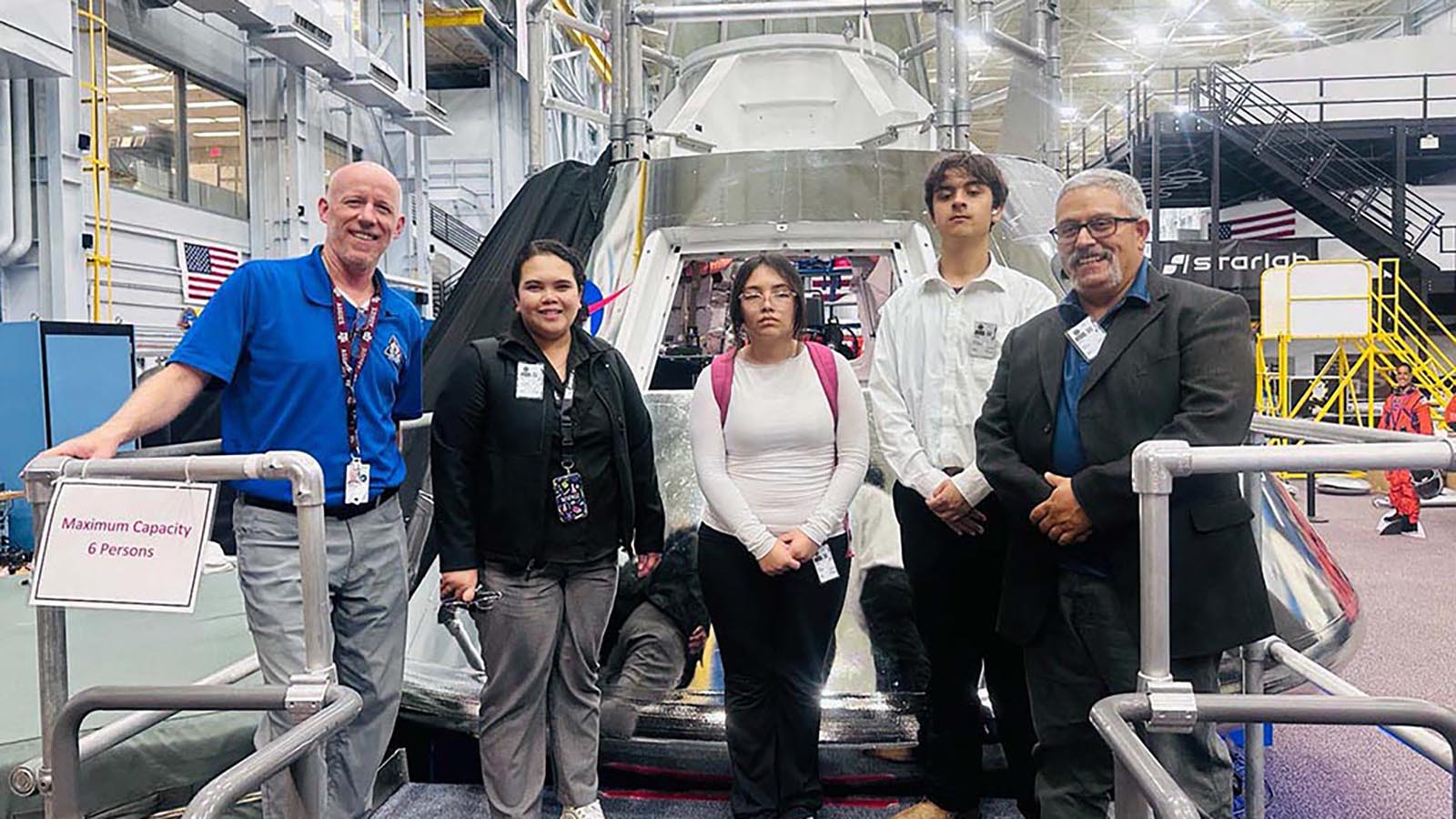
GALLINA, N.M. — For two students from a small rural high school in Northern New Mexico, a recent trip to NASA’s Johnson Space Center turned classroom learning into a real-world aerospace experience.
Olivia Salazar and Martin Gutierres, Coronado High School students and participants in UNM-Taos Dual Credit, traveled to Houston in October with teachers Irish Quidet and Frank Chacon to present a Flight Profile Review for a high-powered rocket they are designing and building from the ground up.
The Coronado team was one of just 33 teams from 17 high schools across Texas, New Mexico, Colorado, and Oklahoma selected to present their work to Chris Madsen, NASA’s Guidance, Navigation and Control System Manager for the Orion spacecraft program.
As part of the SystemsGo program, students must demonstrate through advanced mathematical modeling that their rocket can safely reach supersonic speeds, targeting Mach 1 below 13,000 feet or Mach 1.2 below 15,000 feet. Their presentations included calculations involving vehicle mass, aerodynamics, drag, and motor thrust, all critical factors in rocket performance.
For Salazar and Gutierres, the experience offered a rare opportunity to showcase their work before a NASA engineer while collaborating with fellow aspiring scientists and engineers from across the region.
“This exercise is essential in guiding the students through the rocket design process,” says Burns. “It prepares them for presentations they will give in college and when they enter the workforce. It also gives them an opportunity to network with other teams who are solving the same problem.”
Following the presentations, students received a behind-the-scenes look at some of NASA’s most iconic facilities. The tour included Artemis Mission Control, Apollo Mission Control, the Shuttle Avionics Integration Laboratory, and Building 9, home to full-scale spacecraft mockups used for astronaut training and mission preparation.
For Coronado High School, located in the rural community of Gallina in Río Arriba County, the trip demonstrated how access to hands-on STEM opportunities and college coursework through UNM-Taos Dual Credit can open doors to experiences far beyond the classroom.
SystemsGo is a nonprofit program that challenges students to design, build, and launch rockets while applying principles of science, technology, engineering, and mathematics. The program, which began in 1996, now serves schools across Texas, New Mexico, Colorado, and Oklahoma.
The Coronado team’s next challenge will be transforming their designs into a finished rocket for a SystemsGo launch event this spring, where they will attempt to send their creation soaring past the speed of sound.
Launch events are open to the public and will take place April 20-22 in Jal, New Mexico; April 21-May 1 in Stonewall, Texas; and May 6-7 in Smith Point, Texas. For more information about SystemsGo, visit http://www.systemsgo.org/.