
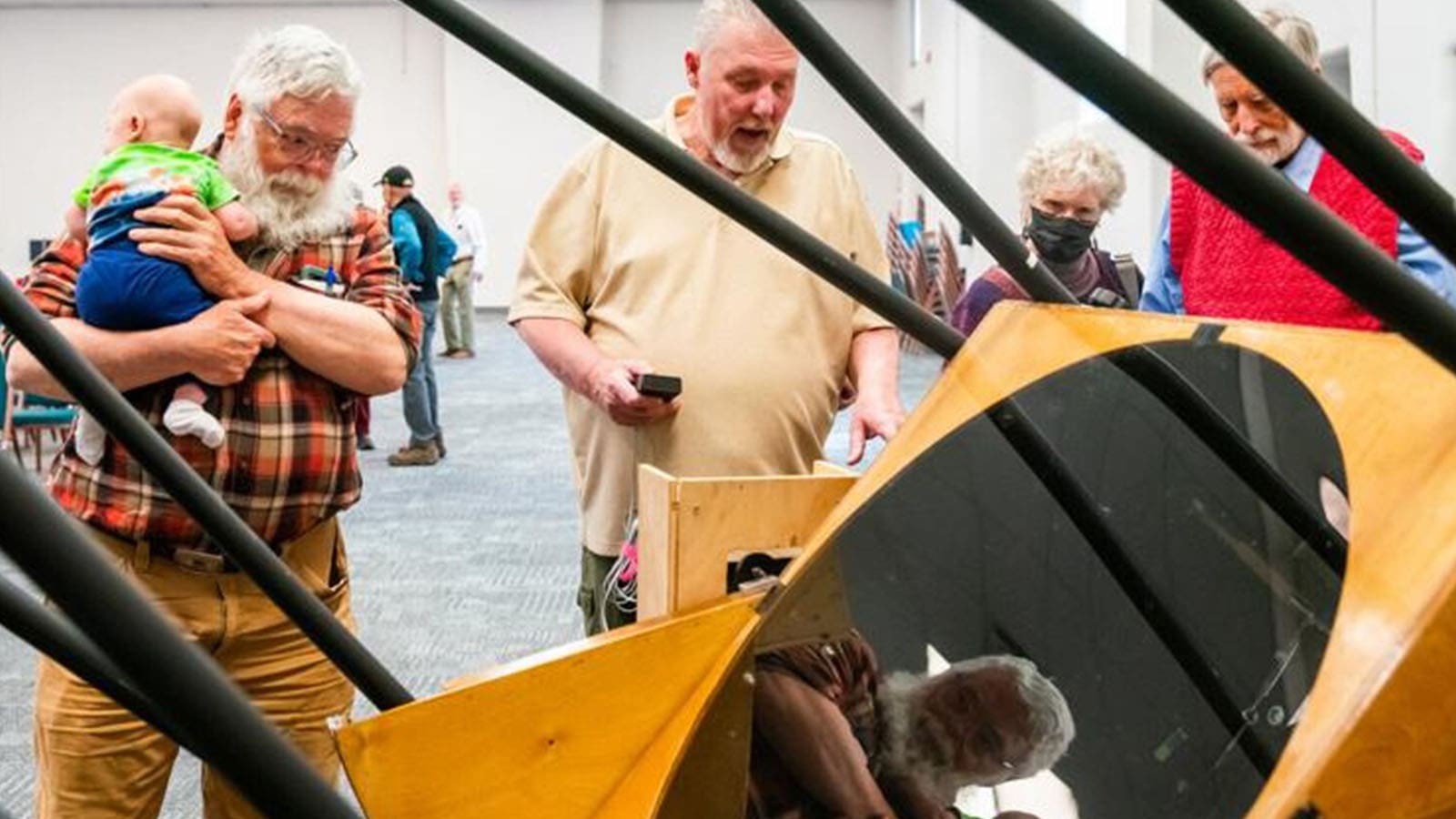
UNM-Taos hosted a public meeting on May 14 detailing a project that will broaden the horizons of students in the literal sense: Cielo Centro, an observatory the college has been planning for four years that will house the largest public-access telescope in the state.
According to a timeline provided by the school’s construction project manager, construction for the observatory — and an adjacent classroom and outdoor amphitheater — will begin in October.
UNM-Taos math and science department chair Dr. Colin Nicholls said the finished product will be accessible to the public and to students. The observatory and classroom will also be available for use by local K-12 students participating in STEM programs.
Local astronomy club El Valle Astronomers lent a Dobsonian telescope of their own to show at the Tuesday meeting. The telescope is just slightly smaller than the one that will be installed at UNM-Taos. The Cielo Centro telescope boasts a mirror 36 inches in diameter that can gather 23,000 times more light than the human eye. The telescope itself is over 12 feet tall. Through it, people can observe celestial bodies 65 million light years away. The telescope was donated to the college four years ago by the late Melinda King, a nearby resident.
According to Samantha Toquinto, a project manager for Sam Sterling Architecture, which has been contracted for the project, UNM wanted to find a location for the observatory that was close enough to campus utility hookups and classrooms, but isolated enough to avoid light interference form nearby buildings. Light has been a major focus of the project — the school plans on installing artificial light barriers and natural vegetation to shield the observatory from headlights of passing vehicles.
The interior and exterior of the new structures will mimic the tan and taupe colors of other buildings around campus, Toquinto said. To gauge the common design themes around campus, Toquinto and a team of consultants toured the campus to get a sense for common materials, colors and architectural themes, such as outdoor seating and the utilization of natural light.
Observatories are not like other structures, featuring roofs that open and allow telescopes to peer into the night sky while being protected from the exterior elements.
Nicholls said they looked at several options for the observatory’s roof. They ruled out a dome because it can be physically limiting. While visiting other observatories in the four corners region, they settled on the “roll-off roof observatory” model, which, unlike a dome, has only one slim opening. Moreover, a roll-off roof would enable multiple telescopes to operate simultaneously while also offering protection from wind and other elements. The finished observatory will feature a storage area for other telescopes and an observation deck where students can set them up or bring their own.
A classroom and amphitheater will accompany the observatory. The amphitheater will be meant to serve a variety of functions, from entertainment to education. Nicholls said having an outdoor area that can serve as a classroom is ideal for astronomy classes since celestial bodies can be referenced instantly. The classroom will be able to house 40 students at a time and is even equipped to perform science experiments, presenters said during Tuesday’s presentation.
Around the observatory cluster will be a “solar system trail” that meanders around the campus and will feature the planets of the Milky Way galaxy scattered throughout the trail. This trail will be meant to depict the vast distances between the planets on a small scale.
One remaining challenge is the eyepiece of the telescope, which sits at the top of its 8-foot-long optical tube and is only accessible by ladder, conflicting with the project’s emphasis on ADA compliance and accessibility. However, Nicholls shared a plan to construct an 8-foot-long periscope to install along the optical tube. This would allow people to view the stars from a seated position.
“The easy way is to put a camera in the eyepiece and then project it onto a screen, and we’ll do that,” Nicholls said. “But there’s something aesthetically improper about that. I want the light that started in the galaxy 65 million years ago and has just arrived here to be the light that enters my eye and your eye. I want you to see the real thing, not some photograph of the real thing.”
As a public telescope, Nicholls said UNM-Taos aims to provide educational resources to visitors, specifically to spread awareness of New Mexico’s Night Sky Protection Act and its supporting local and county ordinances, which set limits on outdoor lighting in the are.
“About one percent of people in the western world can see the Milky Way from their yard,” Nicholls said. “I can see the Milky Way from my yard. Most of us that live anywhere outside the central town can probably do that. We have a valuable resource here. We need to preserve it and enhance it; we don’t need to destroy it. We need to preserve it and build things, so that we can value our connections to art, to culture, to history, to science.”
This November, residents of New Mexico will be voting on a General Obligation bond, which if it passes would funnel $1.5 million in funding to the Cielo Centro project. The money has already been pooled, and the vote will be based on whether or not the money will go toward the project.
— By Liam Easley, Taos News